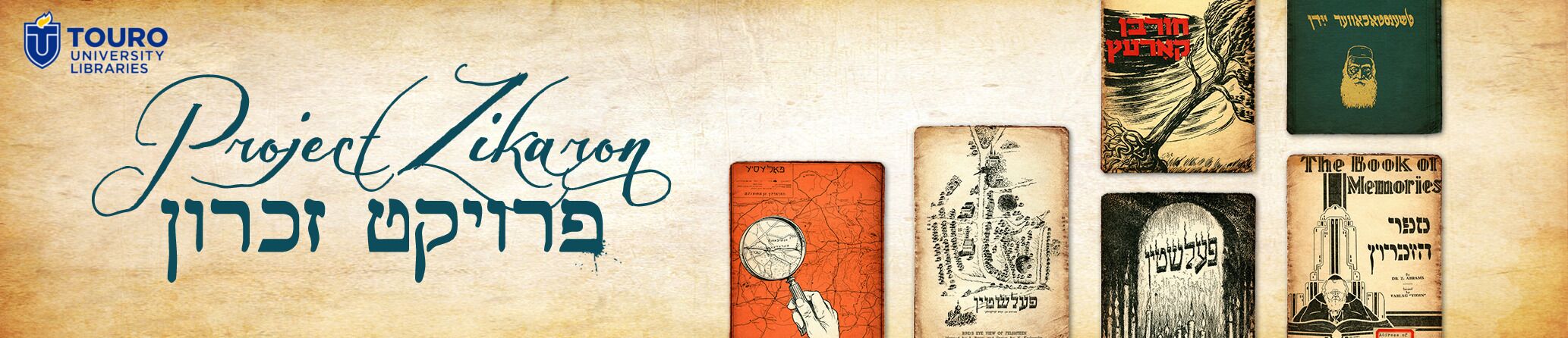
Selected Resources: Project Zikaron’s treasures lie behind the names of thousands of localities. Below is a small sampling of rare and noteworthy items.
 Pinkas of the Tax Collectors of Frankfurt am Main, 1710s-1742 (1710s-1742) ( Autobiographies )פנקס הגובים בק"ק פראנקפורט ד'מיין, ת"ע - תק"ב
Project Zikaron is the only website to provide digital images of pinkasim (Jewish communal registers) and their transcriptions. A product of a cooperative agreement between the Russian National Library and Touro University’s Project Zikaron in 2019, this unique pinkas (communal ledger) contains the ordinances of the tax collectors of the Jewish community. It was begun shortly after the great fire of Frankfurt of 1710 but includes material from the 1680s. See the overview and the accompanying annotated transcription made by Touro College Libraries.
 Yahadut Lita: temunot ve-tsiyunim [Lithuanian Jewry: Its History in Pictures] (1959) ( Autobiographies, Documents and Manuscripts )יהדות ליטא: תמונות וציונים
This yizkor book (memorial volume) for Lithuania was published in 1959 and includes hundreds of photographs of towns, their rabbis, and their community members. Direct links to the exact page are provided for each locality. Project Zikaron has digitized and made fully searchable over 1,200 yizkor books, including 166 yizkor journals, and has indexed over 3,700 localities mentioned in them. This includes the digitization of over 500 yizkor books not previously freely available on the internet. Yizkor journals are primarily for Bialystok, Krements, and Zhelekhov.
 Milkhome-shtoyb [vol. 2] (2018)מלחמה שטויב [באנד צוויי]Eisenberg, Shimen (Ha-Rav) (1888-1950) v. 2
Transcribed from the original manuscript, Project Zikaron is proud to present the second volume of Rabbi Shimen Eisenberg’s Yiddish-language memoirs which depicts the horrors suffered by the Jewish community of Krasnopollya, Belarus from 1917 until 1923. Though the text does not mention where the events occurred, Rabbi Eisenberg’s late son Dr. Isaac Eisenberg provided us with this information along with a copy of the original manuscript. See the English-language introduction for more details. Project Zikaron is making additional manuscripts available for the first time, including the autobiography of Isaac Frank (1876-1960), a Gerer Hasid who immigrated to America in 1904, Avraham Shlomoh Melamed’s third volume of memoirs about life in the Crimea from 1914 until 1920, and Raya Kagan’s reminisces of her childhood in a Jewish agricultural colony in the Ukraine in the early 1900s.
 Between Two Worlds: The Memoirs of a Physician (1952) ( Autobiographies, Documents and Manuscripts )Gordon, Benjamin L. (1866 - 1965)
In his autobiography, Benjamin L. Gordon devotes over 60-pages to his hometown of Zemaiciu Naujamiestis (Nayshtot-Sugind in Yiddish), Lithuania, for which no yizkor book exists. Some Jewish autobiographies include hundreds of pages about their authors’ hometowns in Eastern Europe. Autobiographies are often the only source of communal life in scores of former Jewish communities. For an English-language autobiographer who devotes hundreds of pages to his hometowns in the Ukraine, click here. Project Zikaron is the only website to index the localities described in thousands of autobiographies and provides direct links to the exact page where they are mentioned.
Gordon’s memoirs is one of the most outstanding 19th-century Jewish autobiographies of an Eastern European Jew written in English. He describes in detail his experiences and hardships in studying in kheyder and later in various Lithuanian yeshivas. He also provides some important overall descriptions of various aspects of Jewish life in Eastern Europe. For example, he describes small-town rabbis (p. 80), a typical Jewish mother in Eastern Europe (p. 67), his experiences of his voyage on a boat to America in 1890 (p. 135), etc. As a physician, he writes about the many diseases which used to kill of so many, particularly children, before the advent of modern medical advances. Upon immigrating to New York in 1890, he became part of the inner circle by Rabbi Ya’akov Joseph, the chief rabbi of New York City (p. 142), for a short while.
Though documents from America give his year of birth as the early 1870s, his autobiography gives two indications that he was born in 1866. He mentions that at the age of 13 he was friends with his relative of the same age Boris (Berl) Schatz (1866-1932), who later became the founder of the Bezalel school of art in Jerusalem (p. 72). He also indicates that when he was fifteen years old, the pogroms of April 1881 occurred (p. 88).
 Izmir Müsevi Yetim Mektebi (Talmud Tora) Takvimi: Calendrier edite au profit de l'Oprhelinat Israelite de Smyrne annee 5691: 1930-1931 (1930) ( Communal Histories )קאלינדארייו פור איל אנייו 5691 אידיטאד'ו אל פרופ'יטו דיל תלמוד תורה די איזמירנה
This calendar booklet (luaḥ in Hebrew) is one of over 30 calendars/almanacs written in Ladino (Judeo-Spanish), which have been digitized by Project Zikaron. To see a complete list, click Ladino Calendars. They are filled with a plethora of information on three Jewish communities in particular: Saloniki (Thessaloniki), Greece; Izmir, Turkey; and Istanbul, Turkey.
These calendars/almanacs were printed between the late 19th century and the middle of the 20th century. Though they are less than 100 pages long, they shed a bright light on the daily life of these unique communities and cultures and the language which they spoke, namely Ladino. Apart from recording the Hebrew and secular calendars of the year, each booklet abounds with supplementary information.The Izmir calendars were published by the local Talmud Torah as a fundraiser and contain several chapters on the activities of local organizations. This is followed by an astoundingly broad list of donor names by city of residence, containing for examples Jews from New York, Los Angeles, Atlantic City, Buenos Aires, São Paulo, Cuba, Alexandria, Cairo, Corfu, cities in England, and mainland Europe. While the Saloniki calendars list all the secular and Christian holidays, the Turkish ones prominently list the many Muslim holidays and their corresponding Jewish dates.
At the end of each Saloniki calendar are details of the Oriental Railway detailing the information and costs needed for the many stops along the way from Saloniki to Paris. Cities such as Monastir (Bitola, Macedonia today) are given prominent mention on the train routes due to the close connection between the Jewish communities of Greece and Monastir. The Saloniki and Istanbul calendars have an interesting feature on each month's calendar page: the header for each month lists the name of a different synagogue in the city, thus allowing us to record the names of the community's synagogues at any given year and the disappearing of some at a certain date and new names being added at later dates. Already mentioned in the calendars from the late 19th century are Ashkenaz and Italian synagogues. Another interesting feature of some of the Saloniki volumes is a list of the numbers of years passed from important Jewish dates, such as the Redemption from Egypt, Destruction of the Temples, and the Spanish Expulsion.
At the ends of the Istanbul calendars, particularly the latter ones, are transliteration to Turkish of crucial Jewish prayers, such as the Kaddish, Shema Yisrael, blessings for the Torah, etc., which indicates a lack of Hebrew literacy among at least part of the community. The Istanbul calendars all begin with a table for boys turning 13 that year so that they can calculate the date of the upcoming bar mitzvah based on their Arabic calendar birthday. All the calendars also include the zmanim (specific times of the day in Jewish law), allowing us to understand the customs of these communities in these matters, which differ surprisingly from one place to the other.With the destruction of Saloniki's Jewry during the Holocaust, the dissolution of Izmir's Jews with the establishment of the state of Israel, and the slow decline of Istanbul's community to emigration and intermarriage (estimated to be over 50% today), these calendars provide a window into the active religious and cultural life of these communities in their heyday.
 Marathi Bylaws of the Sha’are Raḥamim Synagogue of the Bene Israel Indian Community in Kiryat Gat, Israel (1974) ( Communal Histories )
This 29-page mimeographed booklet is an internal publication for the members of the Sha’are Raḥamim synagogue in Kiryat Gat, Israel consisting of regulations in the Mahathi language. The synagogue is used by the small Bene Israel community originating in the Indian state of Maharashtra. Among the 39 bylaws are the following:
- All prayers are to be conducted in Marathi.
- If a member conducts himself contrary to the rules regarding proper comportment in the sanctuary, does anything against the interests of the sanctuary, or engages in activities that harm the sanctuary, the general assembly has the right to remove the member from the synagogue’s membership roll.
- During the general assembly meeting, a member shall not speak more than twice on the same issue. If there is a need to speak a third time on the same topic, he shall request permission from the chair.
 Yizker: dem ondeynken fun Zhitomirer kedoyshim (1921) ( Communal Histories )יזכור: דעם אנדיינקען פון זשיטאמירער קדושיםPublished in 1921, this scarce Yiddish-language volume describes the pogroms which took places in Zhytomyr, Ukraine in 1905, 1919, and 1920, and lists the victims, sometimes including brief biographical details and photographs. Project Zikaron has digitized or made fully searchable other pre-WWII works devoted to the histories of Eastern European Jewish communities, such as those listed below. Some of these primarily describe their communities’ destruction during the Russian Civil War (1917-1921) while others are devoted to their communities’ general histories: Chortkiv, Ukraine; Derazhnya, Ukraine; Dubova, Ukraine; Hvardiske (Felshtin), Ukraine; Humenne, Slovakia; Ivano-Frankivsk (Stanislav), Ukraine; Khmelnytskyy (Proskurov), Ukraine; Latvia – 25 localities; Navahrudak (Navaredok), Belarus; Pinsk, Belarus – 14 localitie; Radomsko, Poland; Pruzhany, Belarus; Rezekne (Rezhitse), Latvia; Sialiba (Seliba), Belarus; Siauliai (Shavl), Lithuania (Shavl), Lithuania; Tarashcha, Ukraine, v.1 & v. 2, and Vilkaviskis, Lithuania.
 Map (1920) and Recollections of Vishey, Lithuania (1988) ( Autobiographies )Aberson, Ruth Miller (1900-2000)In 1988, Ruth Aberson’s son interviewed her about her childhood in Veisiejai, Lithuania and drew a map of Veisiejai as it was in 1920, based on her recollections. Project Zikaron is proud to be making such manuscripts available to the public for the first time.
 Ershte reshime fun di lebns-geblibene Yidn in Varshe (1945) ( Yizkor Books )ערשטע רשימה פון די לעבנס-געבליבענע יידן אין ווארשעThis post-Holocaust volume is entitled Ershte reshime fun di lebensgeblibene Yidn in Varshe (First List of Surviving Jews in Warsaw). This digitized copy was made from the only known extant copy which lies in the hands of a private collector. Unfortunately, the print quality is poor, and some of its pages are blank. Project Zikaron includes scans of many very rare items which are even difficult to locate in major libraries, including this Yizkor book about Rezekne (Rezhitse), Latvia, which was digitized from the only known surviving copy (which lies in a private collection).
 Un di erd hot nisht tsugedekt dos blut [And the Earth Did Not Cover the Blood] (1962) ( Autobiographies, Yizkor Books )און די ערד האט נישט צוגעדעקט דאס בלוטAjzensztadt, Amnon (1919-1998)Our esteemed staff member Rabbi Yitzchok N. Stroh purchased this book at a used bookstore and noticed that it identifies (pages 50,51,342) the name of the composer of the popular Hasidic melody “Utsu eitsa” as Rabbi Zishe Ajzenstadt, the Rebbe of Tsoysmer (Sandomierz). Rabbi Stroh contacted Rabbi Duvid Mayer Rus of Mechon Shirei Duvid (Brooklyn, NY), an expert in Hasidic music, who excitedly told him that researchers had been searching for its composer for years. Click Hasidic Nigunim (Music) for other such works in this genre. This is just one of the untold gems just waiting to be discovered on Project Zikaron.
 Sefer ha-masaot be-erets Kavkaz uvi-medinot asher meʻever le-Kavkaz... mi-shenat 5627 ad shenat 5635 (1884) ( Communal Histories )ספר המסעות בארץ קוקז ובמדינות אשר מעבר לקוקז וקצת מדינות אחרות בנגב רוסיאChorny, Joseph Judah (1835-1880)This Hebrew-language travelogue by Joseph Judah Chorny describes dozens of Jewish communities in the Caucasus region (Kavkaz) of the former Russian Empire during his travels there from 1867 to 1875. Today, these localities are found in Russia, Azerbaijan, and Georgia. Direct links to the exact page are provided for each locality. Project Zikaron has indexed a number of travelogues, including those of Benjamin of Tudelain Europe, Asia, and Northern Africa ca. 1165-1173 ; I.J. Benjamin of Asia and Northern Africa from 1846-1855; and Ephraim Deinard of the Crimea in the late 1870s.
 Seyfer ha-zikhroynes: erinerungen fun a Litvishen maskil in dray velt theylen: Eyrope, Amerika un Afrika
Jews in South Africa: Of All Matters Concerning Jewish and Judaism in S. Africa (1916) ( Communal Histories )ספר-הזכרונות: עראינערונגען פון א ליטווישען משכיל אין דריי וועלט טהיילען: אייראפא, אמעריקא, און אפריקאHoffmann, N.D. (Nechemia Dov) (1860-1928)Project Zikaron includes many rare autobiographies, such as this Yiddish-language volume from 1916 which is the earliest South African Jewish autobiography. The last 100 pages are devoted to the history of the Jewish community of Cape Town, including biographies and photographs of its rabbis and community leaders. Konstitushon der khevre anshe Lyubavitsh nusakh ho'Ari of Boro Park… [Constitution of Chevra Anshei Lubawitz Nusach HoAri of Borough Park] (192-?) ( Autobiographies )קאנסטיטושאן דער חברה אנשי ליובאוויטש נוחס הארי' אף בארא פארק: געגרינדעט ר"ח סיון תרע"ד
Up until the 1950s, many American synagogues had their constitutions printed, mainly in Yiddish. The small (4” x 5 ¼”) Constitution of the Chevra Anshei Lubawitz Nusach HoAri of Borough Park consists of 21 articles (sections) with 155 bylaws. Some of the articles included are as follows: The Rights of Members, Sick Benefits, The President’s Duties, The Finance Secretary’s Duties, and Fines for Members. Article 19, entitled “Synagogue Ordinances” includes a surprising bylaw (#128): “No member should remove his tallis before the concluding prayer Aleinu, lest he be fined 50¢.”
Though from the cover it appears to have been printed in 1914, that was simply the year that the synagogue was founded. It was actually printed in the 1920s by the Mendel Beilis Press. Beilis was a Russian Jew accused of ritual murder in Kiev in a notorious 1913 trial known as the Beilis Affair which shook up the Jewish world. After Beilis was acquitted, he immigrated to America in 1921 where he ran his own press. By 1930, he had become a life-insurance agent. This is the only recorded item known to have been printed in the Mendel Beilis Press.
Click here for the constitutions of other synagogues. Ohale Aharon: ḥelek 2: kolel she'elot u-tshuvot … (1936) ( Communal Histories )אהלי אהרן: חלק ב': כולל שאלות ותשובות ...Mileikowsky-Samunov, Eliyahu Aharon (Ha-Rav) (1860-1947)As of the launching of Project Zikaron, this work of rabbinical responsa by Rabbi Eliyahu Aharon Mileikowsky-Samunov (1860-1947) has not been digitized elsewhere. In addition, his nine-page description of his years of study in the yeshiva in Volozhin at the end of his book not been noted by scholars. Also of interest are his short biographies of his father, who was the rabbi of various communities in Kurland (now Latvia), and of his nephew, Rabbi Efrayim Samunov (1860-1932), who was married to the granddaughter of Rabbi Naftali Tsvi Yehuda Berlin (1816-1893), commonly known by the acronym Netsiv, who was the celebrated head of the yeshiva in Volozhin. Project Zikaron makes available many such unknown treasures. Click here for a photograph of the author.
 Mayn lebens-geshikhte: farshidenartige pasirung'n un epizod'n fun a yosem (1928-1929) ( Pinkasim )מיין לעבענס-געשיכטע: פארשידענארטיגע פאסירונג'ן און אפיזאד'ן פון א יתוםGoldenshteyn, Pinkhes-Dov (1848-1930)In this nineteenth-century memoirs, arguably the first by a Jewish religious functionary, the author Pinkhes-Dov Goldenshteyn (1848-1930), a shochet, describes his life in numerous cities and towns in Ukraine, Crimea, and elsewhere. Touro University Press has published Michoel Rotenfeld’s annotated English translation entitled The Shochet: A Memoir of Jewish Life in Ukraine and Crimea in two volumes. Click here for more information.
 Di zikhroynes fun mayn geburt shtot Lida [Memoirs of My Birthplace, Lida] (c. 1965) ( Autobiographies )די זיכרונות פון מיין געבורט שטאט לידאIlutovich, Jacob (1883-1974)Transcribed from the original typewriten manuscript, the author of this unpublished yizkor book reminisces in great detail about Lida and the many families he knew.
 Constitution and By-Laws of the Hebrew Congregation "Dispersed of Judah": Together with a Complete List of Members from its Organization to the Present Date: Incorporated June 4th, 1847 (1860) ( Autobiographies, Communal Histories )
This rare synagogue constitution was printed in 1860 in New Orleans. In the early days of New Orleans’ settlement by Europeans, the first Jews to arrive in Louisiana were nearly all Sephardic Jews, generally descendants of Spanish and Portuguese Jews. In 1827, they founded Shangarai Chasset (Sha’arei Chesed), the very first synagogue in the country outside of the original thirteen colonies. By 1847, the Jewish population had become predominantly French and German (Ashkenazi). As a result, a Sephardi named Gershom Kursheedt convinced his fellow businessman Judah Touro (1775-1854) to establish a new Sephardic synagogue, which was called Nefutsoth Judah (The Dispersed of Judah). Kursheedt also tutored Judah Touro into becoming a practicing Jew and America’s first great philanthropist. Having never married and being the last surviving member of the Touro family of Newport, Rhode Island, Judah bequeathed in his will $500,000 (equivalent to some $2 billion today) to institutions around the country, including non-Jewish causes. This 1860 constitution includes a portrait of its benefactor. By 1881, the Portuguese Jewish community had declined to the point where it merged with another congregation. In 1937, the congregation changed its name to the Touro Synagogue, in honor of its original benefactor. Despite the constitution’s insistence on Jewish law being followed (see below), the synagogue eventually joined the reform movement.
The constitution of the synagogues lists the names of its members and the dates that they joined the congregation. It also includes a long list of articles which the synagogue officers and members must uphold. Of note is the requirement in Article VIII that the congregation must always employ a shohet (kosher slaughterer). Article II states that the prayer and ceremonies shall forever be read and performed “according to the manner and customs of the Portuguese Jews, according to Minhag Sephardim.” Article V notes that any members who had at one time been baptized had to make “a public avowal of atonement for such act, according to our laws,” and “any member who marries in contravention to the laws of the Jews, shall forfeit all the rights and privileges of membership.”
 Reshimot ha-nedavot mi-bate ha-kenesiyot be-arba'at roshe ha-shanim … ve-ḥeshbon katsar u-khelali shel bet ḥinukh-yetomim ha-kelali me-Elul [5]699 ad Elul [5]703: nosad [5]662 (1943) ( Communal Histories )רשימת נבדבות מבתי-הכנסיות בארבעת ראשי השנים ת"ש תש"א תש"ב תש"ג וחשבון קצר וכללי של בית חנוך-יתומים הכללי מאלול תרצ"ט עד אלול תש"ג: נוסד תרס"בThis rare publication list thousands of individual donors, organized by synagogue affiliation, to the Jerusalem orphanage which is today known as Beit ha-Ḥinukh ha-Sefardi, for the years 1939-1943. Most of the synagogues were located in Jerusalem, such as the neighborhoods of Mishkenot Sha'ananim (p. 46) and Talpiot (p. 42). The synagogues were founded by Jewish immigrants from all over the Middle East, North Africa, Asia, and Italy, as reflect in the synagogue names, all of which have been indexed. A number of the Jerusalem synagogues listed were attended by Bukharian Jews and located in Jerusalem's Bukharian Quarter, such as the Moussaieff Synagogue (pp. 12, 30), the [Baba] Tama Synagogue (p. 26), the Sahidof Synagogue (p. 28), the Suleimanoff Synagogue (p. 31), and the Beit Yehudayoff Synagogue (p. 41). Note that the Moroccan Jewish community is called the "Ma'aravim" (the Westerners) since Morocco is far to the West (pp. 15,30). Also note that the Betish Synagogue was attended by Kurdish Jews (p. 41), who are also called Adat Targum (p. 37). The Taweig Synagogue was for Jews from Baghdad (p.42), and the Haji Adoniya was established by the Jews of Mashhad, Iran (p. 21). Apparently the only synagogue oustide of Israel from which donations were solicited was the Silvera Synagogue, which was Aleppo''s main synagogue (p. 46), while the Adas Synagogue in Jerusalem was founded by Jews from Aleppo (p. 19).
 The Scroll: June '62: Torah Vodaath High School (1962) ( Communal Histories )Project Zikaron includes digitized yearbooks of yeshiva, seminaries, and other Jewish educational institutions. Well-known institutions, like Yeshiva Torah Vodaath in Brooklyn, have their own entries, otherwise they are listed in the entry for the city or town in which they are located. For a list of additional entries which are not cities, towns, or villages, click here.
- Location icons created by Freepik - Flaticon
- Click here by Cuputo from Noun Project (CC BY 3.0)